

Air Canada Pet Policy: Complete Guide to Traveling with Pets

By flightshelpcenter
Published on December 8, 2025
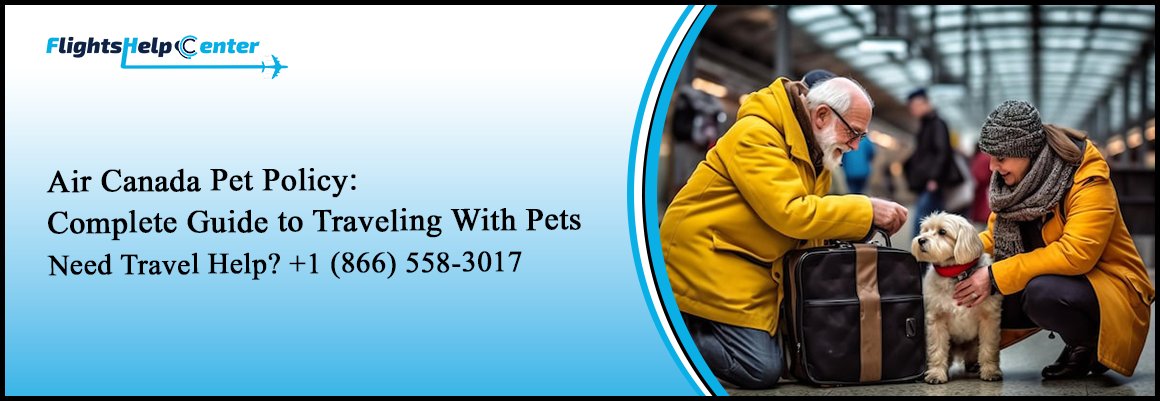
Air Canada’s pet policy for 2025 provides several options for travelers flying with dogs or cats, whether on domestic routes, international flights, or long-distance journeys requiring cargo transport. The airline allows small pets in the cabin, medium or large pets in the baggage hold, and oversized or internationally restricted pets through Air Canada Cargo. Because the rules vary depending on the type of pet, destination, season, and aircraft, it is essential to understand the detailed requirements before booking. Many travelers also use support lines such as +1 (866) 558-3017 to confirm availability and prepare documentation, especially for international pet travel.
Quick Overview – What is Air Canada Pet Policy?
Air Canada’s 2025 pet policy allows small dogs and cats to travel in the cabin in soft-sided carriers, while larger pets must be checked as baggage or shipped through Air Canada Cargo. The airline follows strict IATA-based kennel rules and country-specific import requirements for international flights. Pet fees vary by route, and many travelers contact support at +1 (866) 558-3017 to confirm aircraft space, kennel sizes, and documentation needs.
Here are the key points at a glance:
- Small dogs and cats may travel in the cabin if they fit inside a soft-sided carrier that can slide fully under the seat.
- From June 1, 2025, hard-sided carriers are no longer allowed in the cabin.
- Pets too large for cabin travel must fly as checked baggage or via Air Canada Cargo, depending on size and destination restrictions.
- Checked pets must use a hard-sided IATA-approved kennel, ventilated on 3–4 sides depending on the route.
- The maximum allowed kennel size is 292 cm (length + width + height), with a 45 kg combined weight limit for pet and kennel.
- International trips may require health certificates, rabies proof, microchips, or import permits, depending on the destination.
- In-cabin pet fees range from $105–$324 CAD/USD, depending on domestic or international routes.
- Certain destinations, such as the UK or Australia, require pets to travel cargo-only, with no in-cabin arrivals permitted.
- Snub-nosed or strong breeds may face additional restrictions or require reinforced kennels.
- Booking must be completed through Air Canada Reservations, and travelers often confirm details through +1 (866) 558-3017.
In 2025, Air Canada emphasizes safety-focused updates by requiring soft-sided carriers for cabin pets and reinforcing IATA rules for all kennels used in checked or cargo transport. Whether you are flying domestically, relocating internationally, or transporting a large dog into Canada, the airline recommends confirming space, aircraft limitations, and documentation early.
Air Canada’s Updated 2025 Pet Travel Rules
Air Canada introduced updated guidelines effective June 1, 2025. Soft-sided carriers are now mandatory for in-cabin pets, replacing hard-sided options to ensure flexibility under varying seat dimensions. Pets must remain inside their carrier for the entire flight. For larger animals, the baggage hold and cargo programs continue to follow IATA’s international standards, including ventilation and kennel construction requirements. These updated rules apply across all routes, although international flights may have additional restrictions due to importing country laws.
In-Cabin Pet Policy at Air Canada: What Travelers Should Know
Air Canada permits small dogs and cats to fly in the cabin if they can comfortably fit inside an approved soft-sided carrier that slides fully under the seat in front of the traveler. The carrier must be well-ventilated, leak-resistant, and sized so that the pet can stand, turn, and lie down. Because every aircraft type has different under-seat dimensions, confirming carrier size compatibility before the flight is important. The airline does not publish a direct weight limit, but the pet must be small enough to fit safely in the carrier without forcing or compressing the structure.
Seats such as exit rows, bulkheads, and premium cabins with enclosed footwells are not available for passengers traveling with pets. Only a limited number of pets are permitted per flight, which means pet reservations must be added after purchasing a ticket. Many travelers call +1 (866) 558-3017 or Air Canada Reservations directly to register their in-cabin pet, as online pet booking is currently unavailable.
Fees for in-cabin pets typically range from $105–$126 CAD/USD on flights within Canada and the United States, and from $270–$324 CAD/USD on international flights. Fees are paid at the airport during check-in.
Pet Policy for International Flights
Air Canada’s pet policy on international flights is more detailed because every destination has its own import rules. Countries may require health certificates, microchips, rabies documentation, import permits, or government-endorsed forms. Certain destinations, including the United Kingdom, Australia, New Zealand, and Hong Kong, do not allow pets to arrive in the cabin under any airline. In such cases, pets must enter through cargo only.
If you are moving to Canada with a dog, the Canadian Food Inspection Agency may require rabies vaccination proof, age verification, and additional inspections upon arrival. Import requirements differ for personal pets versus commercially imported animals. Travelers should review the entry rules well ahead of their flight and coordinate veterinary appointments accordingly.
Because international pet travel can be complicated, many passengers choose to verify route-specific policies and import rules through support lines such as +1 (866) 558-3017, especially when transporting a pet to or from restrictive countries.
Checked Baggage Pet Policy
Medium-sized dogs or pets that cannot fit in a cabin carrier may travel as checked baggage on select Air Canada flights. The baggage hold is pressurized and temperature-controlled to keep animals safe. Not all aircraft accept pets in the hold, especially during extreme weather conditions, so seasonal embargoes may apply in both hot and cold climates.
Kennels for checked pets must meet IATA standards. They must be hard-sided, secure, and ventilated on at least three sides for domestic and U.S. flights, and on all four sides for international travel. The maximum kennel size permitted is 292 cm in combined length, width, and height. The combined weight of the pet and kennel must not exceed 45 kg (100 lb). Pets heavier than this limit may only travel through Air Canada Cargo.
Check Here → Air Canada Baggage Fees
Air Canada Cargo: Transporting Large or Internationally Restricted Pets
Air Canada Cargo handles animal transport for oversized pets, snub-nosed breeds, strong breeds requiring reinforced kennels, and all destinations that restrict in-cabin or checked-baggage pet entry. Cargo shipments follow IATA’s Live Animals Regulations and require secure, fully compliant kennels. Some breeds, such as pitbulls, mastiffs, and other strong dogs, may require heavy-duty metal crates with reinforced fasteners. Air Canada Cargo also manages pet bookings for unaccompanied animals.
Cargo pricing varies by route, pet weight, kennel size, and handling requirements. Exact quotes are provided at the time of booking, as rates are not standardized. Many passengers request cargo assistance by calling +1 (866) 558-3017 or Air Canada Cargo customer service.
Air Canada’s Service Dog Policy
Service dogs trained to assist individuals with disabilities are accepted free of charge on all Air Canada flights. The airline may request documentation that confirms the dog is trained to perform tasks related to a disability. Service dogs must remain leashed or harnessed during the flight and usually stay within the passenger’s foot space. Emotional support animals are not recognized as service animals under current rules, and therefore cannot fly in the cabin unless they meet standard pet requirements.
Breed Considerations and Safety Restrictions
Brachycephalic dogs and cats, such as bulldogs, pugs, and Persian cats, may face restrictions because their short nasal passages can make breathing difficult under stress or warm temperatures. Air Canada may restrict their travel during certain seasons or require cargo handling instead of in-cabin or checked baggage transport. Strong breeds such as pitbulls and mastiffs may need reinforced kennels that meet IATA Container Requirement 82. Travelers should confirm breed policies before booking.
Air Canada Pet Fees – How much does it Cost
Pet travel fees depend on the type of transport:
- In-cabin fees generally range between $105–$126 CAD/USD for domestic or U.S. flights, and $270–$324 CAD/USD on international flights.
- Checked baggage fees follow similar ranges but vary by route and region.
- Cargo fares are based on weight, dimensions, and destination, with individualized quotes.
Passengers often confirm fee details through support at +1 (866) 558-3017, especially when comparing in-cabin, checked, and cargo options.
Tips for Flying With Pets on Air Canada
Travelers should book early, prepare required documents, confirm carrier or kennel requirements, and arrive at the airport ahead of schedule. Pets must remain inside their carriers throughout the flight, including during boarding, taxiing, and landing. Selecting non-stop flights is recommended, especially for older pets or long-distance travel. For international travelers or those moving with pets, coordinating vet appointments, vaccines, microchips, and import paperwork well in advance is essential.
Conclusion
Air Canada offers several ways for pets to travel safely, whether in the cabin, as checked baggage, or through cargo. Understanding the carrier requirements, weight limits, international rules, and seasonal restrictions is the key to planning a smooth trip. The updated 2025 rules, including mandatory soft carriers for in-cabin travel, align with global safety standards and make the journey more predictable for pet owners. Travelers who need to verify aircraft compatibility, pet availability, or documentation requirements often reach out to dedicated support services such as +1 (866) 558-3017 for fast guidance.
Frequently Asked Questions
How much is the pet fee on Air Canada?
The pet fee on Air Canada ranges from $105–$126 CAD/USD for domestic and U.S. flights and $270–$324 CAD/USD for international flights. Fees vary depending on whether the pet travels in cabin, as checked baggage, or via Air Canada Cargo.
Does Air Canada allow pets in the cabin?
Yes. Small dogs and cats are allowed in the cabin if they fit inside a soft-sided carrier that slides fully under the seat. Hard-sided carriers will not be permitted in cabin after June 1, 2025.
How do I add a pet to my Air Canada flight?
You must call Air Canada to add a pet after booking your ticket, as pet reservations cannot be added online. Travelers commonly confirm space and register pets through +1 (866) 558-3017.
How strict is Air Canada with pet carriers?
Air Canada enforces strict rules on carrier size, ventilation, and flexibility under the seat. Only soft-sided carriers are allowed in cabin, and pets must fit comfortably without compressing the carrier. Checked kennels must be hard-sided and fully IATA-approved.
Does Air Canada allow dogs on planes?
Yes. Dogs may travel in cabin, as checked baggage, or via cargo depending on size, weight, breed restrictions, and aircraft availability.
Can I fly with a dog on Air Canada internationally?
Yes, but international pet travel must follow destination-specific rules. Some countries only allow cargo arrival, while others accept pets as checked baggage or in cabin. Documentation may include rabies certificates, microchips, and import permits.
What is the maximum kennel size for pets on Air Canada?
Air Canada allows kennels up to 292 cm linear (L+W+H) for checked pets, with a combined pet-and-kennel weight limit of 45 kg (100 lbs). Larger animals must travel via Air Canada Cargo.
Can I take a 25 lb dog on an Air Canada flight?
A 25 lb dog usually cannot travel in cabin unless it fits in a soft-sided carrier under the seat. Most dogs of this size must travel as checked baggage or via Air Canada Cargo.
Are snub-nosed breeds allowed on Air Canada?
Snub-nosed breeds (bulldogs, pugs, boxers, Shih Tzus) may face restrictions due to breathing risks. They may require cargo transport only or be limited by seasonal temperature embargoes.
Does Air Canada allow pets on international flights?
Yes, but not all countries accept pets in cabin or as checked baggage. Countries like the UK, Australia, New Zealand, and Hong Kong require pets to enter cargo only.
How much does it cost to fly a pet internationally on Air Canada?
International in-cabin pet fees are typically $270–$324 CAD/USD. Cargo pricing varies by pet size, kennel weight, and destination and is provided via quote request.
Can I buy a seat for my dog on Air Canada?
No. Air Canada does not allow passengers to purchase a separate seat for pets. In-cabin pets must remain inside their carrier under the seat for the entire flight.
What are the new rules for dogs entering Canada?
Dogs entering Canada must meet CFIA import requirements, including rabies vaccination proof, age confirmation, and, in some cases, inspection upon arrival. Rules differ for commercial vs personal pets.
How do I add a dog to my Air Canada reservation?
Contact Air Canada directly to register your dog, as pet reservations cannot be completed online. For faster processing, travelers often call +1 (866) 558-3017.
How can I fly my pet internationally with Air Canada?
To fly a pet internationally, ensure the country’s import rules are met, prepare health certificates, verify microchip requirements, and choose cabin, checked baggage, or cargo based on destination restrictions. Cargo is required for many international arrivals.
Related Posts

Related Posts

How much does it cost to upgrade on a United flight?
United Airlines Upgrade Fee is one of the most searched topics among travelers looking to enhance comfort without paying full…

Missed Your Delta Airlines Flight? Here’s Exactly What to Do
Missed your Delta Airlines flight? Don’t worry — the Delta Airlines Missed Flight Policy gives you clear options to rebook,…

JetBlue Baggage Fees: What to Know
If you’re planning a flight, understanding JetBlue Baggage Fees is essential to avoid surprises and extra charges at the airport.…